Thursday, 30 August 2012

Thursday Video: metamorphic rocks in the Giant's Causeway

3 comments
Giant's Causeway
Photo courtesy of Rick, from Flickr
Remember the story a few weeks ago about The National Trust including the creationist hypothesis as a plausible explanation for the origin of the Giant's Causeway (Northern Ireland) at their new visitor's centre?
Let's forget the sectarian nonsense and let's focus in science, the marvel of reason that tries to explain our word through our observations and logical deductions.

Today, for Thursday Video, a film produced by the Open University about metamorphic rocks (and also igneours rocks!) in and around the Giant's Causeway.
Have fun!

Tuesday, 28 August 2012

Saltash Bells, of John Surman

3 comments

I have been thinking for a while that this blog could be turned into something -slightly- more personal, and from now on I will write from time to time some posts not directly related with geology. As a geologists who works in an office, in front of two screens, mapping satellite images and doing cross-sections, I listen to a good amount of music. I enjoy very much reading (at home!) and I am also a keen photographer, so why not having some small input from this "other" Jorge?

I hope you understand this, and I would like to read your thoughts. Please, leave some comments and let me know what do you think about this decision of including some more personal posts (not much... just from time to time) in this highly specialised and technical blog.

Ground control, here I go.

Saltash Bells - John Surman

Saltash Bells, of John Surman I have been listening for a few weeks to Saltash Bells, a jazz album of John Surman. I have never been a big fan of jazz, fundamently because of my own ignorance of this genre. But this music, together with other European jazz albums -Garbarek, E.S.T., Rypdal, etc.- are filling up to 80 or 90% of the music I have listened to during the last two months or so.

John Surman is an English saxophonist. Saltash Bells is his latest solo work, and he plays all the instruments (soprano, tenor and baritone saxophones, alto bas and contrabass clarinets, harmonica and synthesizer) heard in the album. He has a long list of published albums, but this is the first in a long time that he publishes as soloist. Surman is one of the jewels of the German discographic ECM. If you don't know ECM, you are missing very good music!

This recording has an unmissible English flavour, taking inspiration from folk themes and harmonies that can easily make you imagine you travel through the West Country. In fact, the music was tought as companion for a TV series of documentaries about this part of the United Kingdom, but this project never saw light.
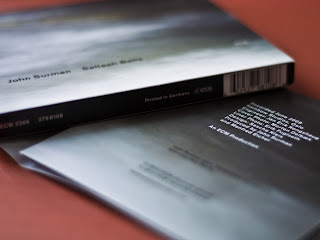

Saltash Bells, of John SurmanThe music of Surman is clear, crystalline and very melodic. Background canons and cyclic phrases result in a very atmospheric soundtrack. Whistman's Wood opens the album with a very nice musical electronic texture, which perfectly entangles different instruments blending them in a very beautiful song. It is easy with such music to feel the breeze of the the cliffs of Dorset or the water spray from the beaches of Cornwall.

Some compasses even remind me of my home music, from Asturias, in the north of Spain. I hear The Crooked Inn and Sailing Westward and I can feel at home. The Atlantic connection of peoples and cultures is very evident in this music, and I very much like this in European music.

A common line in most of the songs is the background sound of bells, which actually give the title to the album -it's the memory as a child of the Sultash Church bells across the waters what he tries to reproduce with a synthesizer-.

This music is perfect for working. It is calm, not distracting and so atmospheric that you will listen to it serveral times before you even realise it.  At least it let me work on 2DMove!

If you want to buy a very good album (and buy it as a CD, with much better quality than mp3!), just buy Saltash Bells.

You can hear to a sample here: ECM Player.

Album: Saltash Bells
Artist: John Surman
Date:2012
Publisher: ECM Records GmbH (Munich). Catalogue number 2266


Track list

track list Saltash Bells1 Whistman's Wood
2 Glass Flower
3 On Staddon Heights
4 Triadichorum
5 Winter Elegy
6 Ælfwin
7 Saltash Bells
8 Dark Reflections
9 The Crooked Inn
10 Sailing Westwards


Thursday, 23 August 2012

Thursday video: structural geology II

1 comments
Second part of the last "Thursday video". Sorry for the delay; I have been pretty busy with other stuff!


Thursday, 31 May 2012

Thursday video: structural geology I

16 comments
Today's video introduces structural geology (part I). It is presented by Jonathan Bergmann and includes an interview with Dr. Randall Marrett. It is a good introduction to our little corner of the geological room, and it may be useful if you are deciding now what do you want to have as a profession later on. Be aware: structural geology is cool!!

If you are studying geology in school, or in college, this video is also useful for introducing the basic concepts of structural geology. If you have any questions... well, just ask, that is why there are comments in this blog!

Enjoy!


(yep, I know... I forgot to upload the video yesterday... ahem...)

Thursday, 24 May 2012

Thursday video: Difference between crust and lithosphere

14 comments
Mechanical and chemical division of Earth.
Today's video deals with a topic of tectonics: the difference between crust and lithosphere. Many people mix these two things, and hopefully this video will help you to know when to talk about crust, and when to talk about lithosphere. It is very easy, but many people just don't pay enough atttention!

This video has been produced by Khan Academy, a non-profit organisation which aims "to provide a high education to anyone, anywhere". A really good initiative. Visit their site here, where you will find many resources of virtually anything!: www.khanacademy.org 

Enjoy!

Source: http://www.youtube.com/watch?v=f2BWsPVN7c4

Thursday, 17 May 2012

Thursday video: the Variscan orocline in Iberia

14 comments
An orocline is an orogenic belt where a change in horizontal direction occurs, characterising the mountain belt by a horizontal curvature or a sharp bend. We can find examples of oroclines in pretty much everywhere. A famous orocline are the Carpathians Mountains, formed by the subduction and continental collision between the European and the Apulian plates during the Alpine orogeny.

The Variscan orogen in Iberia also forms a remarkable orocline (but much older than the Carpathians!), and this video shows its evolution, with emphasis in the different timing of granitic bodies emplacement. Very interesting indeed!


This video is the companion of a paper published in Tectonics last year by a series of researchers From the ODRE group (University of Salamanca), Universidad Complutense de Madrid, Natural History Museum of London, University of Victoria and St. Francis Xavier University, both in Canada.

Gutiérrez-Alonso, G., J. Fernández-Suárez, T. E. Jeffries, S. T. Johnston, D. Pastor-Galán, J. B. Murphy, M. P. Franco, and J. C. Gonzalo (2011), Diachronous post-orogenic magmatism within a developing orocline in Iberia, European Variscides, Tectonics, 30, TC5008, doi:10.1029/2010TC002845.


U-Pb (zircon) crystallization ages of 52 late-Variscan granitoid intrusions from NW Iberia (19 from new data, 33 from previous studies) constrain the lithospheric evolution of this realm of the Variscan belt of Western Europe and allow assessment of the relationship between oroclinal development and magmatism in late-Carboniferous-early Permian times. The U-Pb ages, in conjunction with a range of geological observations, are consistent with the following sequence of events: (i) oroclinal bending starts at 310--305 Ma producing lithospheric thinning and asthenospheric upwelling in the outer arc of the orocline accompanied by production of mantle and lower crustal melts; (ii) between 305 and 300 Ma, melting continues under the outer arc of the orocline (Central Iberian Zone of the Iberian Variscan belt) and mid-crustal melting is initiated. Coevally, the lithospheric root beneath the inner arc of the orocline thickened due to progressive arc closure; (iii) between 300 and 292 Ma, foundering of the lithospheric root followed by melting in the lithospheric mantle and the lower crust beneath the inner arc due to upwelling of asthenospheric mantle; (iv) cooling of the lithosphere between 292 and 286 Ma resulting in a drastic attenuation of lower crustal high-temperature melting. By 285 Ma, the thermal engine generated by orocline-driven lithospheric thinning/delamination had cooled down beyond its capability to produce significant amounts of mantle or crustal melts. The model proposed explains the genesis of voluminous amounts of granitoid magmas in post-orogenic conditions and suggests that oroclines and similar post-orogenic granitoids, common constituents of numerous orogenic belts, may be similarly related elsewhere.